

Kristina Dolgilevica reports from the most dramatic alpine backdrop an archer can imagine

The 6th World Nomad Games (WNG) saw its return to the Games’ original host city, Cholpan-Ata, Kyrgyzstan, and to say it was a return to behold would be an understatement; the action unfolded from 31st August to 6th September. Though it is not the only international multi-sport event to showcase and engage participants in traditional culture, it is most certainly one tailored for extreme sports enthusiasts. Compared to the Naadam Festival, which focuses strictly on Mongolian heritage through living history and pageantry, the WNG is a highly competitive, Olympic-style event that attracts professional traditional sports athletes from all nomadic cultures. These days, the showcase is open to a much broader cultural scope beyond the peoples of Central Asia; otherwise, why would the UK take part, being a predominantly sedentary culture, you might think? Yet, we were all once nomadic, making us all brothers and sisters. The WNG rests on three pillars: ethnosports, ethnoculture, and science, serving as an international platform for these three spheres. Under the Games’ slogan, ‘United by Strength, United by Spirit’, we joined this year’s WNG with the English longbow team for the ground archery events, marking our first team appearance since 2014.

2026 Nomad Games: Key Numbers
This year, Kyrgyzstan played host for the fourth time (2014, 2016, 2018, 2026); interim hosts were Türkiye (2022) and Kazakhstan (2024). A total of more than 3,000 athletes and delegates from 106 countries participated in over 40 sports disciplines, spread across nine locations. This year’s archery entries broke previous records as athlete numbers exceeded 250, with representatives coming from 51 different countries. Though this may not seem like a massive figure, it is worth noting that the WNG enforces a strict policy on team quotas: three female athletes, three male athletes, and one coach per team, with only one team permitted per nation.
One of the most asked questions at the Games was: how much did it all cost, and who paid for it? The WNG was primarily funded by the state budget of Kyrgyzstan, with approximately 336 million Kyrgyz soms (£3.1 million / $3.9 million) allocated to the event’s organising committee (www.24.kg). This sum went towards operations, athlete accommodation, meals (which were delicious and featured plenty of in-season vegetables), and essential logistics. Out of this total, the sports budget accounted for 334.2 million soms, which included an overall athlete prize fund of 61.3 million soms. Furthermore, additional funding was allocated for infrastructure costs; a total of 147.5 million soms (£1.3 million / $1.7 million) went into improving, roads, existing sports facilities, upgrading the Cholpan-Ata Hippodrome, and introducing competition technology, such as integrating electronic target setups for archery and specialised mats or rings for ethnic wrestling disciplines, alongside extra logistical and security personnel.
Logistics: Nomads on Busses
The geographical scale and spread were seemingly gigantic, partly due to calendar clashes between the Games and the 26th Meeting of the Council of Heads of State of the Shanghai Cooperation Organisation (SCO). The latter took place in the capital city of Bishkek on 1st September, with leaders from all ten member states participating, including China, Russia, India, Pakistan, Iran, and Belarus. For the WNG, this meant huge logistical shifts from where the participants were originally meant to be housed before the Opening Ceremony to the competition venues about five hours away from the city. As is often the case, these major, high-security forums are announced closer to the date for security reasons; when they do happen, airspace is restricted or closed, and access to roads and cities is limited. Many of the attending heads of state were present at the Opening Ceremony. All these last-minute amendments and restrictions made us a bit more nomadic than originally planned, except that our mode of transport became a bus rather than a horse. While the logistics committee deserves a round of applause for their quick organisation, participants had to endure several four-to-seven-hour bus rides back and forth to the city for the Opening Ceremony and other compulsory accreditation procedures in Cholpan-Ata. While many complained abundantly about the situation, and it did indeed cause considerable discomfort for many, I highlight this as the only downside to the Games. Hopefully, it serves as a piece of constructive criticism for future iterations: athlete comfort must come first, as such extensive commuting simply tires people out. A lot of the logistics lay on the shoulders of volunteers, and we truly appreciate everything they have done. Any future jobs will surely seem like a walk in the park for these young and efficient men and women.
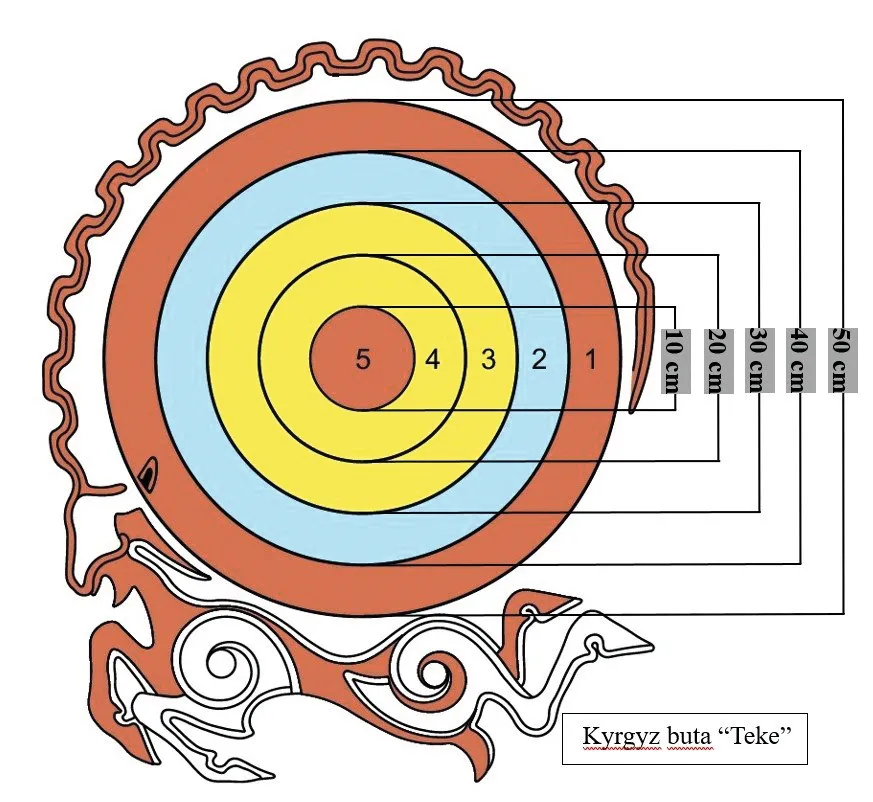
The Kyrgyz target face.
Source – Kristina Dolgilevica
The Opening Ceremony
The Opening Ceremony rightfully deserves a separate mention; to say it was spectacular would be an understatement. Like the whole event itself, the ceremony was financed by the presidential administration. A Kazakh creative studio, Wakeuphana Creativity Lab, Kyrgyzstan’s neighbours and rivals in Kok-Boru (a brutal national equestrian team sport), known for their astonishing spectacles and immersive concerts, was put in charge technically and directorially. They coordinated 2,000 artists, integrating 3D graphics, AR technology, and stunt choreography (the horses were truly something else). The 2026 World Nomad Games Opening Ceremony featured a narrative journey through Kyrgyz and nomadic heritage via a series of symbolic and chronological chapters. The performance blended myth and history, depicting themes of unity, historical conflicts resolved through sport, and the preservation of the nomadic spirit through nature and modernity. The spectacular action took place in the newly built, yurt-shaped Bishkek Arena, which seats 51,000 and featured flawless lighting, decoration, and sound. The ceremony can be viewed in its entirety on YouTube via @AKIpressnews, though witnessing it in real life was certainly much better.
Ground Archery Programme
The Kyrchyn Gorge, with its vast, untamed, and temperamental open plains, played host to the hunting sports, including ground archery, mounted archery, golden eagle hunting, falconry, and Taigan (ancient Kyrgyz sighthound) racing. Kyrchyn also hosted demonstration sports and traditional events, such as the Tug-of-War and the breaking of the vertebral bone. Furthermore, the Gorge presented the massive Ethno-Town, the ‘Universe of Nomads’ complex featuring roughly 500 yurts arranged into 15 distinct settlements. It serves as a bustling bazaar where visitors can sample traditional food and shop for local arts and crafts. The complex utilises traditional adobe and clay materials to recreate ancient architecture capable of hosting 100,000 visitors a day; it is set to remain a permanent feature and serve as a long-term tourism destination.

It was against this epic backdrop that the ground archery programme unfolded, featuring three distinct disciplines with archers competing over the course of three days, from 2nd to 4th September. Turkish Puta and Kyrgyz Teke Buta were part of the official competitive schedule. Third, a compulsory 145-metre Korean Gungdo demonstration discipline was organised by the World Traditional Archery Federation on the final day. Here, the top three qualifiers earned the opportunity to win a fantastic prize: flights and accommodation costs covered for the upcoming Ulsan Traditional Archery World Cup in early November this year.
The competitive action began with the native Kyrgyz Teke Buta, shot at 40 metres, with archers loosing nine ends of seven arrows for a total of 63. This target face was unfamiliar to most, which made things particularly interesting. The Kyrgyz target face features five scoring rings, with the outermost ring measuring 50cm in diameter; a devious mountain goat shape encircling the target made it slightly trickier to hit. To add to the complexity, archers shot the event from three different positions, dedicating three ends to each in sequence. The first position was a classical square stance. The second was a reversed or closed stance position; here, however, the archers had to ensure their hips were positioned square in the opposite direction from the target (otherwise known as the standing Parthian shot). The third position was kneeling. In the latter, the archer could choose which leg to prop up, and which would touch the ground; it was against the rules to sit or prop oneself up on the supporting leg, and knee pads were kindly provided. The elimination cut-off was the top 32 on the qualification list, following the same three positions but with only one end for each. The Turkish Puta target event required women to shoot at 60 metres and men at 70 metres. It was likewise subject to the top 32 qualifier elimination cut-off and followed standard rules, with archers loosing seven ends of nine arrows for a total of 63.
A separate note must be made regarding the temperamental nature of the local weather at the venue. The Kyrchyn Gorge presented archers with what was quite possibly the most challenging weather they will ever encounter in their archery careers. During accreditation and badge collection, sports delegates received a very thoughtful gift bag containing a raincoat. We quickly realised that we had better take it with us, as it wasn’t there by accident. We were right. The valley floor sits between 1,600 and 2,000 metres (5,249 to 6,561 feet) above sea level, and at this elevation, the air is noticeably thinner. Furthermore, the high altitude means mountain weather shifts rapidly, transitioning from direct heat to biting cold or sudden downpours within the span of an hour. Archers endured these conditions for three days, shooting under heavy rain, being dried by the scorching rays of the sun during sunny spells, or battling the occasional heavy wind gusts. In other words, this tournament was akin to an SAS training regimen, demanding extreme endurance, self-reliance, and psychological self-regulation. In my opinion, archers who undergo these conditions and leave smiling are ready for any challenge, and our UK Team of English Longbow archers did just that.
UK-TAIA – Historic English Longbow Team
This year, the United Kingdom brought its largest sports delegation in WNG history: 47 people. Six of those were representatives of the UK Traditional Archers’ International Association (UK-TAIA), whose mission is to restore and promote the English longbow presence on the international traditional archery scene. The team composition consisted of two female athletes, Cody Sims and Lila Goodwin; three male athletes, Mark Goodwin, John Stanley, and Harry Sims; and (yours truly) coach Kristina Dolgilevica. A huge round of applause goes to our athletes who braved this challenging tournament. It was their first major competition, and for some, their very first, yet they exceeded all expectations while shooting against the best traditional archers in the world.

The English longbow archery team had been absent since 2014, the first instalment of the WNG, which made our comeback so much more special. Those who are not longbow enthusiasts may be unaware of the logistical challenges faced by longbow archers (or indeed, Japanese yumi users); it is neither easy nor cheap to travel with a bow tube reaching or exceeding two metres in length. However, our historic WNG team was on a mission. As a coach to that team, I was inspired by their dedication to the cause, and we made it work.
The presence of the English longbow, traditionally practised by the inhabitants of the island nations of the United Kingdom, along with its culture and history, remain largely unfamiliar to the predominantly Asiatic bow scene; Asiatic bows are shorter and easier to transport and generally superior in performance.
Furthermore, our mixed-heritage team presented a new traditional outfit concept. While the United Kingdom does not have a single traditional national costume, it can proudly boast a unique national treasure: the English longbow. Because our team shares a mixed heritage native to the United Kingdom, our outfit concept was designed to reflect and blend English (Anglo-Saxon), Scottish, Welsh, and Irish (Celtic) lineages and cultures. At the same time, the garments remained practical and suited to the terrain and competition requirements. All team members were united in shooting a single bow type: historically accurate, D-section laminated longbows, bridging the weapon’s legendary medieval military legacy and Georgian or Victorian sporting heritage. The standout piece was the kilt. To move away from the association with familial Scottish tartans, a concept introduced and popularised in the 19th century, or the more ancient Great Kilt associated with the 16th-century Scottish Highlands, the UK-TAIA opted for solid-coloured, earthy, short kilts with no patterns. Not many will know this, but kilt-type garments were widely worn throughout the history of the British Isles. For example, from the 11th century onward, Irish and Gaelic warriors wore the léine (or léine-croich): a long, unpatterned linen tunic or wrapped garment often dyed in solid saffron yellow, forest green, or black. In medieval Wales, historical records describe the use of the brithfe, plain woollen plaids worn as utilitarian, wrap-around clothing for manual labour. We paired the kilt with a Ghillie shirt, the most informal, comfortable shirt for archery, and used natural materials like leather, wool, and cotton for the rest of the outfit.
That unified, non-factional British look, which honours the Celtic and Scottish roots of our team members, perfectly suits both the sport and the landscape in its utility. The competition took place near Lake Issyk-Kul, a high mountain region, and kilts allow easy leg movement and comfort on rough, steep ground. The concept was incredibly well-received and gave us plenty of opportunity to discuss our history, including interviews with the National Kyrgyz broadcasting companies. It was a highly successful mission, and a giant first small step towards bigger things for the English longbow.
For more information on the Games and results visit: www.worldnomadgames.org
To learn more about UK-TAIA visit: www.uk-taia.org
Next 7th World Nomad Games: 2028, Kazan, Tatarstan.
Final Rankings for UK-TAIA Team
Kyrgyz 40m (Women):
Cody Sims: 58/80
Lila Goodwin: 68/80
Kyrgyz 40m (Men):
Mark Goodwin: 53/119
Harry Sims: 67/119
John Stanley: 87/119
Turkish Puta 60m (Women):
Cody Sims: 63/80
Lila Goodwin: 67/80
Turkish Puta 70m (Men):
John Stanley: 58/118
Harry Sims: 80/118
Mark Goodwin: 96/118